A scene, then a question.
The shop. The wet string. A room full of men who disagree. He should give you something to think about—and want to hear your answer.
Benjamin Franklin is eighty-one, gouty, vain, and still curious. Pull up a chair. He would like to know what you do for a living.
Apply for the text pilotThe text pilot is working. Access is by personal invitation.
Applications open now · First invitations planned for early October 2026.
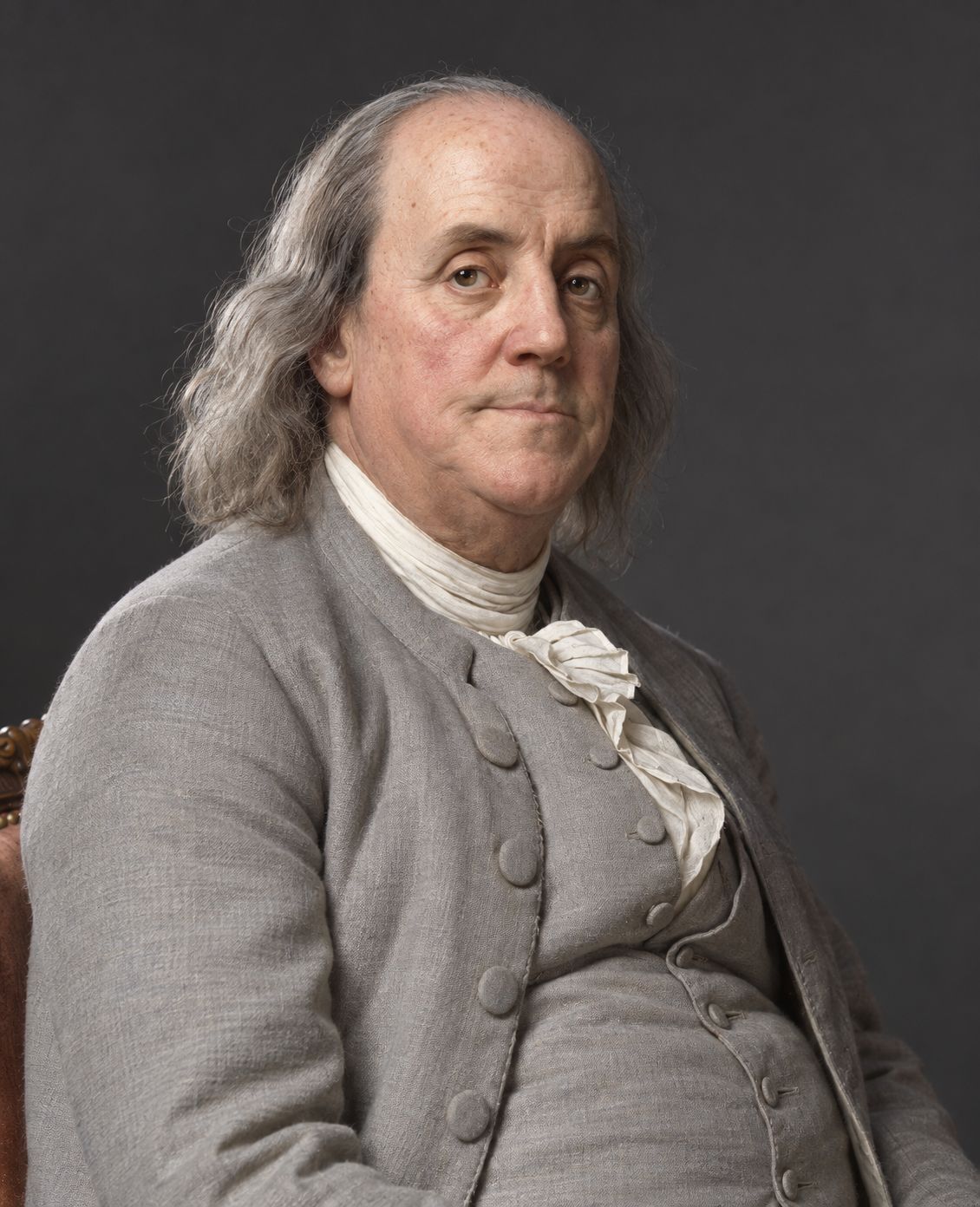
There is a man behind the familiar portrait. A printer with ink on his account, a taste for experiment, and a few things he has yet to put right.
The shop. The wet string. A room full of men who disagree. He should give you something to think about—and want to hear your answer.
The day and season follow yours. The year stays 1787. His memories stop at that date; anything beyond it reaches him as a visitor’s strange account.
Vanity, family, slavery, years away from home. The conversation is meant to leave his difficult history visible, including what he failed to do.
The opening exchange
as an introduction.
“I am Franklin, of Philadelphia. Printer, not a monument. The year is 1787, and the stairs argue with my gout. What am I to call you?”
I’m a librarian in a university.
“Then we are in the same trade, only you keep the sheets bound and I used to get them dirty. What question do your readers actually come in with—the one they are ashamed to ask the catalogue?”
Choose a question to include in your pilot application.
Try him beside the press, the electrical experiment, or the portrait. Test whether a conversation opens a question the label leaves closed.
Bring a question from print culture, political thought, or the history of science. Examine the interpretation as closely as the answer.
Ask what books in common can do for a city. Then tell him what your readers need from a library now.
These are the standards we are testing.
Your notes help us find where he falls short.
His present follows your month and day within 1787; later events must never appear as things he already remembers.
The intended source base includes his writings, letters, and contemporary records of his scientific and civic work.
This is an AI-generated historical interpretation. Most speech is dramatic paraphrase; a documented quotation needs an identifiable source.
The aim is to acknowledge a gap rather than fill it with a legend. The pilot asks you to test that promise.
These source families inform the character’s memory. Their use and the accuracy of his answers are part of the pilot review.
Historical records available to the project are not automatically memories available to Franklin on a given date.
The text pilot is already working. We are gathering historians, educators, librarians, curators, and curious readers to test it with us. Tell us where the man fails and the statue returns.
We review requests individually and invite a small group. When access opens, each approved participant will need to sign in with their own approved account. There will be no anonymous or open access to the chat.
Bring a real question from your discipline.
Mark a specific reply and add a note: a wrong fact, a thin answer, or a moment that felt like a real conversation.
Send the conversation and your comments together to our team for analysis. The relevant context travels with your notes.
The planned tester tools will put comments directly inside the chat and package everything for you. No copying transcripts, attaching files, or writing a separate report—just talk, comment, and send.
Participation in the pilot is free. We can arrange a small, supervised trial with your institution and gather feedback through the same planned chat-commenting tools. Each participant’s access must be approved.
If you find it useful and are willing, we also welcome a letter on your institution’s letterhead describing what you tested and its educational or interpretive value.
Tell us who you are and what you would like to ask. Applications are reviewed personally. An invitation is not guaranteed.
Your name, email, role, organization, message and choices are stored for the project’s organizers to review and respond to. They are not displayed publicly or sold. Submitting does not verify your email, create a chat account or grant access.
You may use this form to request correction or deletion of your details. Short-lived records help limit repeated automated submissions.
The text pilot is already working. Apply now for a place in the invited test group. First invitations are planned for early October 2026.
Applications open · Chat by invitationNext comes voice conversation, with as little delay as possible. The aim is an easy, hands-free exchange, with the same character and historical boundaries.
Voice is the next planned stageAn Unreal Engine figure of Franklin, with lip-sync, facial expressions and emotional performance. The same person, now visibly present.
In the development planThese are our working targets for a volunteer project. We will keep participants informed as the work progresses.
This is an entirely volunteer project. There is no project budget; the creator pays for the model servers personally. Participation is free, and we are not asking for money. What we need most is curiosity, time, and thoughtful criticism.
We are not running a fundraising campaign. If you would like to offer an unconditional financial contribution, you are welcome to write to us—we may accept it. Support does not buy access or move anyone ahead in the pilot.